You already know science matters.
You just never found a book that made you feel that way.
Most popular science books fall into one of two traps. They are either so simple they feel patronizing, or so dense they require a glossary just to follow the first chapter. Neither one keeps you reading past page thirty.
The books on this list were chosen because they make the subject feel alive without talking down to the reader. Whether you are picking up science for the first time, returning to it after years away, or looking for something to share with a curious teenager, these are strong options worth your time in 2026. If you are searching for the best new science books of 2026, top popular science reads, or the best pop science books covering modern topics like AI and climate change, this list was built for you.
Quick Answer: The best popular science books 2026 are ones that explain real science through story, conversation, or vivid everyday examples rather than lectures or lists. The right book depends on what draws you in. Some readers want a single surprising idea explored in depth. Others want a wide range of topics through a character they enjoy following. All of the books below have been chosen because they do at least one of those things well.
What Makes a Popular Science Book Actually Work?
Before the list, it is worth being clear about how these books were selected.
Each book on this list was evaluated against the following criteria: accessibility for readers without a science background, scientific accuracy, quality of storytelling and readability, ability to inspire further curiosity, relevance to questions modern readers are actually asking, and suitability for teenagers or curious adults.
The best popular science books share a few practical qualities. They start with a question the reader already has, even if they did not know they had it. They answer that question honestly, without trading accuracy for false simplicity. And they connect the answer to something larger, whether that is a bigger idea, a moment in history, or something the reader will notice differently the next time they look out a window.
Story helps. Dialogue helps. A narrator or central character the reader can follow from question to question makes a significant difference.
This list is not limited to books published in 2026. It combines enduring popular science classics with titles that remain especially useful and relevant for readers today. Every selection was evaluated for how well it serves a curious, nonspecialist reader in the current moment.
The List
Editor’s note: Why Don’t Spinning Tops Fall? is published by DeLisi Books, the publisher of this blog. It is included as the featured recommendation because its conversational format, broad subject range, and beginner-friendly explanations closely match the criteria used for this list.
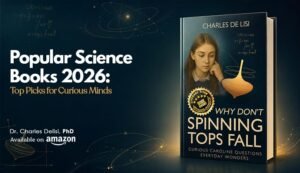
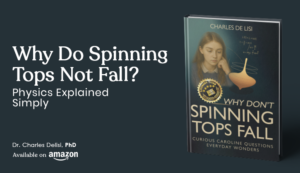
1. Why Don’t Spinning Tops Fall? by Charles DeLisi
Best for: Readers who want several areas of modern science explained through recurring characters, everyday questions, and dialogue. Well suited to curious teenagers and adults with no science background.
Charles DeLisi, Metcalf Professor of Science and Engineering at Boston University and a pioneer of the Human Genome Project, wrote this book as a series of conversations between a curious teenager named Caroline and her family. Her parents are a physicist turned concert pianist and an aerospace engineer turned quantitative analyst. A physicist at a national laboratory is her uncle, while her aunt is a biology professor.
Caroline asks the questions most curious people have but never pursue. Why does the sky turn orange at sunset? How does a plane weighing hundreds of thousands of pounds stay in the air? What is artificial intelligence actually doing when it produces an answer? How are scientists working to address climate change?
The answers are grounded in genuine physics and biology, presented through conversations that feel like the discussions you wished you had been part of. The book covers nine topics across 277 pages, including spinning tops, sound and music, light and optics, the electromagnetic spectrum, climate change, clean energy, and artificial intelligence.
It received a Literary Titan Gold Book Award in 2024 and was reviewed by Kirkus Reviews.
Why Don’t Spinning Tops Fall? is available in ebook, paperback, and hardcover editions. You can explore the book here or purchase it through the Amazon.
One thing to know: The book covers a wide range of topics rather than developing a single idea in depth. Readers looking for a sustained exploration of one scientific concept may prefer a more focused title.
2. What If? by Randall Munroe
Best for: Readers who want real science delivered through humor and completely impractical hypothetical questions.
Randall Munroe, a former NASA roboticist and the creator of the webcomic xkcd, answers questions like: what would happen if you tried to hit a baseball pitched at 90 percent of the speed of light? What if everyone on Earth jumped at the same time?
The questions are deliberately absurd. The physics is entirely serious. Munroe uses genuine calculations, cites real research, and arrives at answers that are both accurate and surprising. The combination works because the humor lowers the barrier without softening the science.
One thing to know: This book is best for exploring individual surprising ideas rather than building a systematic understanding of any scientific field. It is not a structured overview of physics or any other discipline.
3. A Short History of Nearly Everything by Bill Bryson
Best for: Readers who want a broad, single-volume introduction to the history of scientific discovery across multiple fields.
Bill Bryson spent years reading scientific literature and interviewing researchers because he realized, at some point as an adult, that he did not understand how anything worked. Not really. The result covers cosmology, geology, paleontology, chemistry, and biology in a single readable narrative, focusing as much on the people behind discoveries as on the discoveries themselves.
One thing to know: This is the longest book on the list. Readers looking for a quicker entry into popular science may prefer to start elsewhere and return to Bryson when they want more depth and breadth.
4. The Order of Time by Carlo Rovelli
Best for: Readers who are comfortable with science and want a short, meditative exploration of a single idea: what physics actually says about time.
Rovelli argues that time as we experience it does not match what modern physics describes. There is no universal present. The flow of time emerges from thermodynamics and entropy rather than being built into the structure of the universe. The book is short, precise, and genuinely unsettling in the best way.
One thing to know: This is not an introductory book. Readers with no prior exposure to physics may find some concepts difficult to follow without additional context. Start with Seven Brief Lessons on Physics if you are new to Rovelli’s work.
5. The Disappearing Spoon by Sam Kean
Best for: Readers who enjoy history, biography, and storytelling and want to encounter chemistry through those lenses rather than through formulas or tables.
Kean organizes the history of chemistry around the periodic table, using each element as an entry point into a story: a scientific rivalry, a wartime crisis, a medical discovery, a geopolitical accident. The structure means you can read it in almost any order depending on which elements catch your attention.
One thing to know: This book is strongest for readers drawn to chemistry and scientific history. Readers primarily interested in physics, AI, or climate science may find the other selections on this list more directly relevant.
6. Surely You’re Joking, Mr. Feynman! by Richard Feynman
Best for: Readers who want to understand how a genuinely curious scientific mind works, told through the personal stories of one of the twentieth century’s most celebrated physicists.
This is a memoir, not a conventional science explainer. Feynman talks about his time at Los Alamos during the Manhattan Project, his habit of cracking safes as a hobby, his work as an artist, and his deep conviction that playfulness and curiosity are essential to serious intellectual work. The science appears in how Feynman thinks rather than in formal explanations.
One thing to know: Readers looking for clear explanations of specific scientific topics will not find them here. This book is about the texture of scientific curiosity rather than its content.
7. Seven Brief Lessons on Physics by Carlo Rovelli
Best for: Readers who want the most efficient possible introduction to the ideas that define modern physics.
Seven short lessons, each a few pages long, covering general relativity, quantum mechanics, the cosmos, elementary particles, quantum gravity, probability and time, and what it means that we exist in the universe we are trying to understand. Short enough to read in a single sitting, but worth reading more than once.
One thing to know: The brevity is a strength and a limitation. Each lesson opens a door without fully walking through it. Readers who want more depth will need to follow up with additional reading.
How to Choose the Right One
The right book depends on what you are looking for.
If you want several areas of modern science explained through recurring characters, dialogue, and everyday questions, Why Don’t Spinning Tops Fall? by Charles DeLisi is the strongest choice on this list for that specific kind of reading experience.
For breadth and historical context across all of science, start with Bryson. Readers who want a single idea explored with precision and elegance should start with Rovelli. To enjoy science without feeling like you are studying it, start with Munroe or Feynman.
Any of them will remind you that science was never meant to be boring. It was always just a matter of finding the right way in.
Explore More on the Blog
For a closer look at the science inside Why Don’t Spinning Tops Fall?, the DeLisi Books blog covers topics from the book in detail. Recent posts include How Do Planes Fly? The Physics Nobody Explains and Orange Sunset Cause and the Science Behind It.
Interested in science explained through everyday questions and family conversations? Explore Why Don’t Spinning Tops Fall? by Charles DeLisi, available through the Amazon in ebook, paperback, and hardcover editions.
Frequently Asked Questions
Q1: What are the best popular science books for beginners in 2026?
Strong options for beginners include Why Don’t Spinning Tops Fall? by Charles DeLisi, which explains physics, AI, and climate science through conversations, and What If? by Randall Munroe, which uses humor and real calculations to answer absurd hypothetical questions. Both assume no prior science background. A Short History of Nearly Everything by Bryson is also accessible but considerably longer.
Q2: What is a good science book for teenagers?
Why Don’t Spinning Tops Fall? is especially suitable for curious teenagers. Its central character, Caroline, is a teenager whose questions drive every chapter of the book. The science is accurate and the tone is conversational rather than academic. It received a Literary Titan Gold Book Award and was reviewed by Kirkus Reviews.
Q3: Which popular science books use stories or dialogue?
Why Don’t Spinning Tops Fall? is built entirely around conversations between Caroline and her family. A Short History of Nearly Everything reads as a continuous narrative through the history of scientific discovery. Surely You’re Joking, Mr. Feynman! is a memoir that tells science through personal stories. All three are driven more by narrative than by explanation alone.
Q4: Which book is best for physics, chemistry, or a broad overview of science?
For physics specifically, Seven Brief Lessons on Physics or The Order of Time by Rovelli are efficient starting points. Readers interested in chemistry through history and biography may prefer The Disappearing Spoon by Kean. Those seeking a broad overview across multiple scientific fields will find A Short History of Nearly Everything by Bryson the most comprehensive single volume on this list. Why Don’t Spinning Tops Fall? covers physics, biology, AI, and climate change across nine chapters.
Q5: What makes Why Don’t Spinning Tops Fall? different from other popular science books?
Most popular science books focus on a single subject or follow a single author’s perspective. Why Don’t Spinning Tops Fall? covers nine different topics across physics, biology, technology, and environmental science, all through dialogue between a curious teenager and the scientists in her family. The conversational format means the science develops through questions and answers rather than lectures, which makes it a natural fit for readers who learn better through discussion than through explanation.