
Artificial intelligence is becoming easier to use and harder to understand.
You can ask AI to summarize a document, explain a difficult idea, generate an image, help with writing, or analyze information in seconds. But using AI and understanding what it is actually doing are very different things.
For non-technical readers, finding the right book can be surprisingly difficult. Some AI books assume knowledge of mathematics or programming. Others focus almost entirely on predictions about the future without spending enough time on the ideas underneath the technology.
The best AI books for non-technical readers in 2026 explain complicated ideas clearly without requiring a computer science background.
And depending on what interests you most, how AI works, how it compares with human intelligence, how to use it, or what it may mean for society, the right starting point will be different.
Quick Answer: AI Books for Non-Technical Readers
| Book | Best For |
| Why Don’t Spinning Tops Fall? — Charles DeLisi | Readers who want to explore AI within a broader conversation about science and human curiosity |
| Co-Intelligence — Ethan Mollick | Learning how to work with generative AI |
| These Strange New Minds — Christopher Summerfield | Exploring AI, language, and human cognition |
| Artificial Intelligence: A Guide for Thinking Humans — Melanie Mitchell | Understanding AI foundations without excessive hype |
| The Coming Wave — Mustafa Suleyman | Thinking about AI’s broader societal consequences |
| Empire of AI — Karen Hao | Understanding the companies and infrastructure behind modern AI |
1. Why Don’t Spinning Tops Fall? by Charles DeLisi
Best for: Readers whose interest in AI begins with broader scientific curiosity
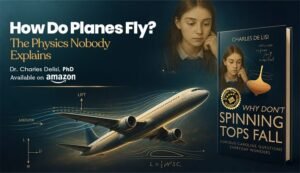
Charles DeLisi’s Why Don’t Spinning Tops Fall? Conversations With Curious Caroline is different from most of the books on this list.
It is not a dedicated AI handbook.
Instead, artificial intelligence appears as part of a much larger exploration of how science helps us understand the world around us.
The book follows Caroline as everyday questions gradually develop into deeper scientific conversations.
Why do spinning tops remain upright?
Why do different instruments playing the same note sound different?
How do airplanes stay in the air?
Why is the climate changing?
And eventually:
What exactly is artificial intelligence doing?
The book’s final major scientific conversation moves through artificial intelligence, machine learning, biological neurons, artificial neural networks, and large language models. That progression lets readers encounter AI alongside the biology and science that helped inspire some of its underlying ideas.
For readers who do not want AI treated as an isolated technological phenomenon, that broader context can be especially valuable.
Why Charles DeLisi’s Approach May Appeal to Non-Technical Readers
The book is built around conversation rather than textbook-style instruction.
Caroline asks questions, misunderstands things, challenges explanations, and follows one idea into another.
That matters because technical subjects are often difficult not because the reader lacks intelligence, but because explanations begin too far into the subject.
Charles takes the opposite approach.
Start with the question.
Build the explanation.
Then ask the next question.
His wider scientific background also gives the AI discussion an unusual context. Charles DeLisi is a biomedical scientist whose work has included computational science and genomics, and he received the Presidential Citizens Medal for his contributions to initiating the Human Genome Project.
But the book does not depend on readers knowing that background.
The science is presented for people who are curious enough to keep asking why.
For readers whose interest in AI begins with broader scientific curiosity rather than a desire to learn programming, Charles DeLisi’s book is a particularly relevant starting point.
Explore Why Don’t Spinning Tops Fall?
Buy Why Don’t Spinning Tops Fall? on Amazon
2. Co-Intelligence by Ethan Mollick
Best for: People who want to use AI more effectively
Ethan Mollick focuses less on the technical history of artificial intelligence and more on how people can work with it.
Co-Intelligence explores generative AI as a collaborator, tutor, assistant, and creative partner.
That makes it especially useful for professionals, educators, students, and writers who are already using AI and want a clearer framework for incorporating it into their work.
You do not need programming knowledge to follow the book.
Choose this if: your main question is, “How should I actually use AI?”
3. These Strange New Minds by Christopher Summerfield
Best for: Understanding AI and human cognition
Christopher Summerfield works across cognitive neuroscience and artificial intelligence, which makes this book particularly interesting for readers fascinated by the relationship between machines and minds.
These Strange New Minds explores large language models and asks difficult questions about language, intelligence, thinking, and understanding.
Why can a machine produce language that appears thoughtful?
How similar is that process to human cognition?
And where does the comparison break down?
Choose this if: the relationship between AI and the human brain interests you more than practical AI tools.
4. Artificial Intelligence: A Guide for Thinking Humans by Melanie Mitchell
Best for: Building a grounded understanding of AI
Melanie Mitchell’s book is a useful introduction for readers who want to understand artificial intelligence without being pulled immediately into either excitement or fear.
She explores the history of AI, what machine intelligence can currently do, where it struggles, and how AI capabilities differ from human intelligence.
The emphasis is on understanding ideas rather than learning to code.
Choose this if: you want a broad foundation that helps you evaluate claims about AI more critically.
5. The Coming Wave by Mustafa Suleyman with Michael Bhaskar
Best for: Understanding the larger consequences of AI
After asking how AI works, another question quickly appears:
What happens when powerful AI systems become widely available?
Mustafa Suleyman, co-founder of DeepMind, focuses on that broader problem.
The Coming Wave examines artificial intelligence alongside other rapidly advancing technologies and asks how societies can benefit from innovation while retaining control over its consequences.
This is less of an introduction to neural networks and more of a book about governance, risk, institutions, and technological power.
Choose this if: you understand the basics and want to think about what increasingly capable AI may mean for society.
6. Empire of AI by Karen Hao
Best for: Understanding the industry behind AI
Artificial intelligence may appear to exist entirely inside software, but modern AI requires enormous physical and organizational resources.
Companies.
Data centers.
Specialized chips.
Energy.
Investment.
Human labor.
Empire of AI examines the institutions and people behind the development of modern artificial intelligence, with particular attention to OpenAI and the race to build increasingly powerful systems.
Choose this if: you want to understand AI as an industry as well as a technology.
Which AI Book Should You Read First?
There is no single answer because these books solve different problems.
If your main goal is to use AI, Co-Intelligence may be the most direct starting point.
If you want a broad conceptual introduction to artificial intelligence, Melanie Mitchell offers a useful foundation.
If you are fascinated by AI and human cognition, Christopher Summerfield takes that question further.
If your interest in AI is part of a larger curiosity about science—biology, physics, technology, the brain, and the way ordinary questions lead to deeper ideas, Why Don’t Spinning Tops Fall? offers a different kind of starting point.
And if you already understand the fundamentals and want to explore power, governance, or the institutions developing AI, The Coming Wave and Empire of AI move the discussion outward.
The useful question is therefore not simply:
What is the best AI book?
It is:
What do I want to understand about AI?
Why Broader Scientific Context Matters
Artificial intelligence is often discussed as though it appeared suddenly.
It did not.
AI draws on decades of work across mathematics, computer science, neuroscience, statistics, engineering, and other disciplines.
Even the term neural network reminds us that some of the ideas behind modern AI were inspired by questions about biological information processing.
This is where Charles DeLisi’s broader approach offers a different perspective.
His book does not pretend that understanding a few AI terms means understanding intelligence.
Instead, AI becomes another scientific question among many others.
A question about artificial neurons can lead to biological neurons.
A question about intelligence can lead to the brain.
A question about machines can lead to computation, energy, physics, or engineering.
And that chain of questions is part of the point.
The book’s preface explicitly frames science as an exploration driven by curiosity, where one question leads naturally into another rather than being treated as a collection of isolated answers. Final Manuscript
If that is how you prefer to learn, explore Why Don’t Spinning Tops Fall?.
For a wider selection beyond artificial intelligence, you can also browse Popular Science Books 2026: Top Picks for Curious Minds.
Frequently Asked Questions
Q1: What is the best AI book for non-technical readers in 2026?
It depends on what you want to learn. Co-Intelligence is useful for practical AI use, Melanie Mitchell provides a broad conceptual introduction, and These Strange New Minds explores AI and cognition. Readers interested in AI as part of a broader scientific conversation may also find Charles DeLisi’s Why Don’t Spinning Tops Fall? especially relevant.
Q2: Is Why Don’t Spinning Tops Fall? an AI book?
Not exclusively. It is a broader science book built around conversations about everyday scientific questions. Artificial intelligence is one of its major subjects, with discussion of machine learning, biological and artificial neural networks, and large language models.
Q3: What AI book should I read if I do not know coding?
All of the books on this list can be approached without programming experience. The best choice depends on whether you want practical AI guidance, a conceptual introduction, a discussion of cognition, or a broader scientific perspective.
Q4: What should I read if I am interested in AI and the human brain?
These Strange New Minds focuses directly on AI and cognition. Charles DeLisi’s Why Don’t Spinning Tops Fall? also connects artificial neural networks with biological neurons as part of its broader discussion of AI and science.
Q5: Are older AI books still useful in 2026?
Yes. Books explaining durable ideas such as machine learning, cognition, neural networks, technological risk, and scientific reasoning can remain valuable even as specific AI products change.
Q6: Do I need a technical background to understand artificial intelligence?
No. You can develop a useful conceptual understanding of AI without learning programming or advanced mathematics. A good introductory book should explain unfamiliar concepts clearly while helping you distinguish established ideas from predictions and hype.