
You have heard the phrase hundreds of times.
Global warming. Climate change. The planet is warming.
But do you actually know what is happening? Not the politics. Not the arguments. The actual physical process taking place in the atmosphere right now, every day, measurable and real.
Most people have an opinion about climate change but cannot explain the mechanism behind it. They cannot say what greenhouse gases actually do, why the temperature keeps rising, or how scientists know the change is caused by humans and not by natural cycles.
That gap between opinion and understanding is exactly what this article is here to close.
Quick Answer: Global warming refers to the long-term rise in Earth’s average surface temperature caused by increasing concentrations of greenhouse gases in the atmosphere. These gases, primarily carbon dioxide released by burning fossil fuels, absorb heat that would otherwise escape into space and re-emit it in all directions, including back toward Earth. The result is a gradual but measurable warming of the planet that has accelerated significantly since the Industrial Revolution.
The Earth Is a Living Organism With a Fever
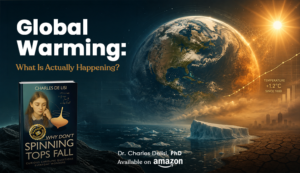
In Why Don’t Spinning Tops Fall? by Charles DeLisi, Caroline asks her father a simple question after seeing him read a newspaper editorial about climate change.
“Does that mean the Earth has a fever?”
Her father pauses. Then he says yes. That is a reasonable, though distressing, analogy.
Just as a fever in the human body is not just about one number on a thermometer but about disruption to the entire system, a rise in the Earth’s average temperature is not just about warmth. It means rising sea levels, shifting vegetation patterns, more intense storms, and disruption to the ecological systems that human civilization has depended on for the past ten thousand years.
Earth is not literally a living organism, but it is a deeply interconnected system in which the atmosphere, oceans, land, ice, and living organisms continuously influence one another. Change one part, and the effects can ripple through the entire system.
Weather Versus Climate: Why the Distinction Matters
Before we can understand global warming, we need to understand the difference between weather and climate.
Weather refers to what is happening in the atmosphere over short periods: days, weeks, or seasons. It changes constantly and unpredictably.
Climate refers to long-term patterns across the entire planetary system: atmosphere, oceans, land, and ice. Climate changes are measured over decades, centuries, and millennia.
This is why a cold winter in one region does not disprove global warming. A single cold year, or even several consecutive cold years, is a weather event. The long-term trend in average global temperature, measured across decades, is climate.
Earth’s average surface temperature has risen by roughly 1.2 degrees Celsius since the late nineteenth century. Scientists track this warming using multiple independent datasets built from measurements collected by weather stations, ships, ocean buoys, and research stations around the world. The long-term warming trend is clear, measurable, and well documented.
What Are Greenhouse Gases and What Do They Actually Do?
The mechanism behind global warming starts with greenhouse gases.
Greenhouse gases are small molecules present in the atmosphere that absorb heat. The major long-lived greenhouse gases include carbon dioxide, methane, and nitrous oxide. Carbon dioxide is the largest contributor to current human-caused warming, and is now present at well over 420 parts per million, compared with about 280 parts per million before the Industrial Revolution, meaning well over 420 out of every one million air molecules are carbon dioxide.
That sounds like a tiny amount. Caroline makes exactly this point in the book. Barry, a geophysicist who becomes part of her extended family, explains why even trace concentrations matter enormously.
Here is the process.
The Sun sends energy to Earth in the form of radiation, primarily in the visible light range. Earth absorbs this energy and warms up. As it warms, it radiates energy back outward, but in a different form: infrared radiation, which is heat.
Here is where greenhouse gases become critical.
As that infrared radiation travels upward toward space, greenhouse gas molecules absorb it and re-emit it in all directions, including back toward Earth. This means energy that would otherwise escape into space is instead redirected back to the surface, slowing the rate at which the planet cools.
Without any greenhouse gases, Earth’s average surface temperature would be approximately minus 18 degrees Celsius. That is about 32 degrees colder than the current average. Human civilization as we know it would not exist.
Some greenhouse effect is therefore not just normal but essential. The problem is not that greenhouse gases exist. The problem is that their concentration is rising, and rising fast.
How Do We Know Humans Are Causing It?
This is the question Caroline pushes hardest on.
“How can you be sure the increase is caused by human activities and not by something natural?”
The answer comes in several layers.
First, the Earth’s climate has changed many times throughout its history due to natural causes: continental drift, volcanic eruptions, shifts in Earth’s orbit, and changes in solar output. Scientists have extensive records of these natural changes going back hundreds of millions of years. The patterns are well understood.
The speed and global pattern of recent warming cannot be explained by known natural factors alone. Global surface temperature has increased faster since 1970 than during any other 50-year period in at least the past 2,000 years.
Second, the chemical signature of the carbon dioxide in the atmosphere has changed in a specific way that identifies its source. Carbon from burning fossil fuels has a distinct isotopic ratio that differs from carbon released by natural processes. Measuring that ratio in the atmosphere directly confirms that the increase in carbon dioxide is coming from the combustion of fossil fuels.
Third, the Keeling Curve. In the late 1950s, geophysicist Charles Keeling began measuring atmospheric carbon dioxide concentrations atop Mauna Loa in Hawaii. The resulting graph, now one of the most important datasets in science, shows a continuous rise in carbon dioxide from about 315 parts per million in 1958 to well over 420 parts per million today. The jagged pattern of the curve reflects seasonal variation as plants absorb carbon dioxide during the growing season and release it in fall and winter. But the upward trend is unmistakable.
Why the Energy Imbalance Is the Core Problem
Here is the clearest way to understand global warming as a physical process.
Earth receives energy from the Sun and radiates energy back into space. When these two flows are equal, the planet is in thermal equilibrium, and its temperature is stable.
When greenhouse gas concentrations rise, the planet radiates less energy into space than it receives from the Sun. The difference accumulates as heat. The planet warms until it reaches a new, higher equilibrium temperature at which it can once again radiate as much as it receives.
The problem is that the new equilibrium temperature is higher than the one human civilization has adapted to over the past ten thousand years. And because greenhouse gas concentrations are continuing to rise, that new equilibrium keeps moving upward.
What Can Be Done?
Caroline asks the question directly.
“Find ways to remove greenhouse gases from the atmosphere? Is that even possible?”
The answer is yes, though not easily.
There are three broad categories of response.
The first is reducing emissions by shifting from fossil fuels to clean energy sources such as solar, wind, and nuclear power. The second is carbon removal, which means actively drawing carbon dioxide out of the atmosphere through technologies or natural systems like forests and soil. The third is short-term interventions to slow warming while longer-term solutions are developed.
Each of these approaches is explored in detail in Conversation 8 of Why Don’t Spinning Tops Fall?, which covers clean energy and how electricity from wind and solar is generated. The full conversation walks through the physics of wind turbines, solar panels, and the energy systems that could replace fossil fuels.
If this explanation made global warming easier to understand, Why Don’t Spinning Tops Fall? Takes the same clear, conversational approach to clean energy, wind, solar power, and other everyday science questions. Explore the full book here, or visit the Shop to get your copy.
Why Understanding This Matters for Teenagers
Caroline is a high school junior when Conversation 7 takes place. She is not a scientist and has not taken Earth Science yet. When Barry first mentions plate tectonics, she does not know what it means.
But by the end of the conversation, she understands the mechanism of global warming, the evidence for human causation, and the scale of what is at stake. Not because she memorized facts, but because she asked the right questions and followed them wherever they led.
That is the point.
The science of global warming is not beyond a curious teenager. It is not beyond any curious adult. The mechanism is real, the evidence is measurable, and the questions worth asking are the same ones Caroline asks around a dinner table in this book.
Explore More Everyday Science
Why Don’t Spinning Tops Fall? Covers climate change, clean energy, spinning tops, flight, sound, light, and artificial intelligence, all explained through warm, story-driven conversations between Caroline and her family.
Written by Charles DeLisi, Metcalf Professor of Science and Engineering at Boston University and a pioneer of the Human Genome Project.
If you know a curious teenager, or you are an adult who wishes science had always been explained this way, Why Don’t Spinning Tops Fall? is designed to make complex ideas approachable without oversimplifying them.
Visit the Shop to get your copy today, or order on Amazon.
Frequently Asked Questions
Q1: What is global warming in simple terms?
Global warming is the long-term rise in Earth’s average surface temperature caused by increasing concentrations of greenhouse gases, primarily carbon dioxide, in the atmosphere. These gases trap heat that would otherwise escape into space, causing the planet to warm gradually over time.
Q2: What are greenhouse gases and why do they cause warming?
Greenhouse gases such as carbon dioxide, methane, and nitrous oxide absorb infrared radiation emitted by Earth’s surface. Instead of allowing this heat to escape into space, they re-emit it in all directions, including back toward Earth. This slows the rate at which the planet loses heat and causes temperatures to rise.
Q3: How do scientists know global warming is caused by humans and not natural cycles?
The current rate of warming is faster than any natural climate change on record that was not caused by a catastrophic event. Additionally, the carbon dioxide in the atmosphere has a specific chemical signature, an isotopic ratio, that identifies it as coming from burning fossil fuels rather than natural sources. The Keeling Curve has tracked the continuing rise in atmospheric carbon dioxide since 1958, while additional evidence, including the chemical and isotopic signature of atmospheric carbon, helps scientists identify fossil-fuel combustion as the dominant source of the increase.
Q4: What would Earth’s temperature be without greenhouse gases?
Without any greenhouse gases, Earth’s average surface temperature would be approximately minus 18 degrees Celsius, about 32 degrees colder than the current average. The planet would be largely frozen, and human civilization as we know it would not exist. Some greenhouse effect is therefore not just normal but essential. The problem is the rapid increase in concentrations caused by burning fossil fuels.
Q5: What can be done about global warming?
The three main approaches are reducing greenhouse gas emissions by transitioning to clean energy, actively removing carbon dioxide from the atmosphere through natural or technological means, and short-term interventions to limit warming while longer-term solutions scale up. The science of clean energy, including how wind turbines and solar panels work, is covered in detail in Why Don’t Spinning Tops Fall? by Charles DeLisi.